
Subaru Forester: Parking your vehicle
Parking brake
To set the parking brake, depress the brake pedal firmly and hold it down until the parking brake lever is fully pulled up.
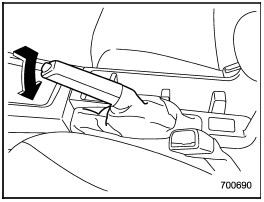
To release the parking brake, pull the lever up slightly, press the release button, then lower the lever while keeping the button pressed.
When the parking brake is set while the engine is running, the parking brake warning light illuminates. After starting the vehicle, be sure that the warning light has turned off before the vehicle is driven.
Refer to “Brake system warning light”.

Never drive while the parking brake is set because this will cause unnecessary wear on the brake linings.
Before starting to drive, always make sure that the parking brake has been fully released.
Parking tips
When parking your vehicle, always perform the following procedure.
- Apply the parking brake firmly.
- For MT models, put the shift lever in the “1” (1st) position when on an upgrade or the “R” (Reverse) position when on a downgrade.
- For AT models, put the select lever in the “P” (Park) position.
- When parking on a hill, always turn the steering wheel as follows.
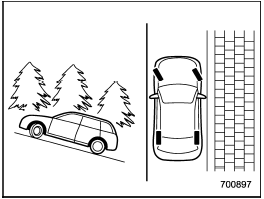
When the vehicle is facing uphill, the front wheels should be turned away from the curb.
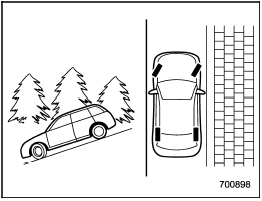
When the vehicle is facing downhill, the front wheels should be turned into the curb.

- Never leave unattended children or pets in the vehicle. They could accidentally injure themselves or others through inadvertent operation of the vehicle. Also, on hot or sunny days, the temperature in a closed vehicle could quickly become high enough to cause severe or possibly fatal injuries to people.
- Do not park the vehicle over flammable materials such as dry grass, waste paper or rags, as they may burn easily if they come near hot engine or exhaust system parts.
- Be sure to stop the engine if you take a nap in the vehicle. If engine exhaust gas enters the passenger compartment, occupants in the vehicle could die from carbon monoxide (CO) contained in the exhaust gas.
- Always set the parking brake firmly when parking your vehicle.
Never rely on the transmission alone to hold the vehicle.
- If your vehicle has a front underspoiler and rear underspoiler (if equipped), pay attention to blocks and other obstructions on the ground when parking.
The underspoilers could be damaged by contact with them.
 Tire pressure monitoring system (TPMS) (U.S.-spec. models)
See also:
Windshield washer fluid
If you spray washer fluid on the windshield
but the supply of washer fluid appears to
diminish, check the level of washer fluid in
the tank.
Washer fluid level gauge
Remove the washer tank filler cap, then
check the fluid level indica ...
If your vehicle overheats
- Do not continue to drive if your
vehicle overheats. Doing so could
cause engine damage or a vehicle
fire.
- To avoid the danger of being
scalded, never remove the radiator
cap while the engine is still hot.
When the radiator cap is ...


